Earn 9%–15% on Senior Secured Bonds.
Lower risk. Fixed returns. Start investing on Aspero with just ₹10,000.
Explore Bonds


FD vs RD: Which one should you choose?
Do you want to grow your savings without taking big risks? Two of the most trusted choices are Fixed Deposits (FDs) and Recurring Deposits (RDs). Both offer guaranteed returns and are easy to open at any bank.
But which one is right for you? The main difference is simple: FDs work best when you have a lump sum of money to invest. RDs are perfect if you prefer saving smaller amounts every month.
Both instruments grow your money and are low-risk. But they serve very different financial needs. Let’s compare FD vs RD and help you decide a suitable savings option.
What is an FD?
A Fixed Deposit (FD) is a savings tool that requires you to invest a lump sum amount for a fixed period and earn a guaranteed interest rate.
Here’s how an FD works:
- You deposit a lump sum with a bank or NBFC for a fixed period. For example: 1, 2, or even 5 years.
- In return, the bank pays you a fixed interest rate, which is usually higher than that of a regular savings account.
- Your money stays locked in, and at the end of the term, you get back your original amount plus the interest earned.
Example: If you invest ₹1,00,000 in a 2-year FD at 6.5% interest, you’ll earn around ₹13,390 in interest by maturity.
What are the different types of FDs
Here’s an overview of the main types of FDs available in 2025:
| FD Type | Key Features | Ideal For |
| Standard/Regular FD | Lump sum, fixed tenure, fixed rate | General savers |
| Tax-Saving FD | 5-year lock-in, Section 80C benefit | Tax planners |
| Senior Citizen FD | Higher rates for 60+, flexible payout | Retirees |
| Cumulative FD | Interest paid at maturity | Maximising returns |
| Non-Cumulative FD | Regular interest payouts | Regular income seekers |
| Flexi FD | Linked to savings, partial withdrawal allowed | Those needing liquidity |
| Digital FD | Opened online, paperless | Tech-savvy investors |
| Floating Rate FD | Rate linked to benchmark | Risk-tolerant investors |
| NRE/NRO FD | For NRIs, tax implications differ | Non-resident Indians |
| Corporate FD | Higher rates, higher risk | Return-focused, risk-tolerant |
Pros and cons of FD
Pros:
- Guaranteed returns
- Higher interest than a regular savings account
- Less risk of losing capital
Cons:
- Money is locked in (you’ll pay a penalty if you break it early)
- Interest is taxable
- Doesn’t beat inflation in the long run
Read More: FD: Powerful Strategies to Boost Returns and Avoid Penalties
What is an RD?
Don’t worry if you don’t have a lump-sum amount to invest in an FD. With an RD, you deposit a fixed amount every month, and over time, it grows with interest.
Here’s how RDs work:
- Deposit a fixed amount every month for a chosen period. This is usually anywhere from 6 months to 10 years. At maturity, you get the total principal plus interest.
- Interest rates typically range between 3% and 8.50% p.a., and the interest is compounded quarterly, just like an FD. It’s perfect if you are a salaried individual with a regular stream of income and want your money to grow steadily over time.
Example: Let’s say you decide to invest ₹5,000 every month in a Recurring Deposit for 2 years (24 months) at an interest rate of 6.2% per annum (compounded quarterly).
By the end of the term, you’d receive around ₹1.3 lakhs (principal plus interest).
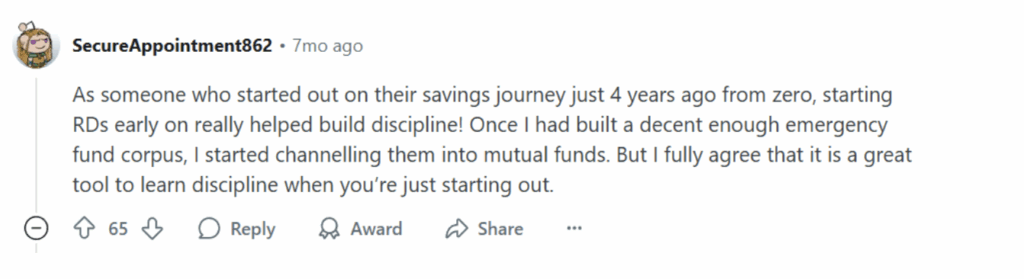
Here’s what a Reddit user says about investing in RDs:
Source: Reddit Post
Pros and Cons of RDs
Pros:
- Encourages disciplined, regular saving
- No need for a lump sum investment
- Flexible tenure
Cons:
- Slightly lower interest rates than FDs
- Missed payments may attract penalties
- Returns are fully taxable.
Read More: Why Fixed Income Investments in India are a smart choice?
FD vs RD: What’s the Difference?
| Feature | FD | RD |
| Investment Mode | Lump sum
(one-time deposit) |
Monthly
(fixed contribution every month) |
| Interest Rate (2025) | 6.25%–7.25% (major banks),
up to 8.80% (Sr. citizens) |
6.0%–6.5% |
| Flexibility | Low (locked-in) | High (regular deposits) |
| Ideal For | Surplus funds, one-time investors | Regular savers, salary earners |
| Payout Options | Monthly/Quarterly/Cumulative | Maturity only |
| Tax Benefits | Only tax-saving FDs (Section 80C) | None |
| Insurance | Up to ₹5 lakh per bank | Up to ₹5 lakh per bank |
| Penalty | For premature withdrawal | For late/missed payments, premature closure |
Which One Offers Better Returns? FD vs RD Returns
FD offers better return than an RD because you invest a lump sum upfront. The full amount starts earning interest right away, which means more compounding power over time.
With an RD, you’re investing smaller amounts every month. So only the earlier deposits get more time to earn interest, while the later ones have less time to grow.
However, understand that returns aren’t just about FD vs RD. They also depend on:
- Interest rates (which vary slightly between banks).
- Tenure (longer terms often fetch better rates).
- Compounding frequency (quarterly, monthly, etc.)
Let’s break it down with a simple example:
| Investment Details | Fixed Deposit (FD) | Recurring Deposit (RD) |
| Total Investment | ₹1,00,000 (lump sum) | ₹5,000/month |
| Tenure | 2 years | 2 years |
| Interest Rate | 6.5% p.a.
(quarterly compounding) |
6.2% p.a.
(quarterly compounding) |
| Maturity Amount (Approx.) | ₹1,13,449 | ₹1,32,088 |
| Total interest earned | ₹13,449 | ₹12,088 |
Here, you can see that:
- FD gives better returns because your money starts earning interest from day one.
- With RD, you end up investing more in total, but your money grows gradually over time and not all at once.
So, if you have a lump sum ready, FD is likely to earn you more.
If you’re looking to build savings month by month, RD helps you stay consistent without needing big capital upfront.
Taxation: FD vs RD
When it comes to taxation, both Fixed Deposits (FDs) and Recurring Deposits (RDs) are treated similarly, but there are a few key points and recent updates you need to know in 2025:
Interest is fully taxable
Interest earned on both FDs and RDs is fully taxable under the Income Tax Act, 1961.
The interest amount is added to your annual income and taxed according to your income tax slab—whether you’re in the 5%, 20%, or 30% tax bracket, you’ll pay tax accordingly on the returns.
For example, if you fall in the 30% tax bracket and earn ₹20,000 in interest, you’ll owe ₹6,000 in taxes.
TDS deduction
Banks deduct TDS (Tax Deducted at Source) on both FD and RD interest if the total interest earned in a financial year exceeds:
- ₹50,000 for regular citizens (raised from ₹40,000 after the 2025 Union Budget).
- ₹1 lakh for senior citizens (also doubled from ₹50,000 in previous years).
TDS Rate: 10% if your PAN is linked with your account, but 20% if you haven’t provided PAN details to your bank. It is deducted at the time the bank credits the interest, not just at maturity.
No tax-free option for RDs
There is no tax exemption on RD investments. The entire interest earned gets clubbed with your taxable income and is taxed at your applicable slab rate.
Unlike your savings account, where you may enjoy a small Section 80TTA/TTB exemption, RD interest doesn’t qualify for any special rebate.
Special case: tax-saving FDs
Tax-saving FDs come with a 5-year lock-in period and are eligible for deduction under Section 80C of the Income Tax Act, up to ₹1.5 lakh in a financial year.
But remember: Only the principal invested qualifies for the deduction. The interest earned is still taxable at your slab rate and can be subject to TDS.
RDs
Source: Reddit Post
Are you still confused with “What If My Total Income is Below the Taxable Limit?”
If your total annual income (including FD/RD interest) is under the basic exemption limit, you can submit Form 15G or 15H to the bank and avoid TDS deductions. However, you’ll still need to declare all interest income when filing your returns.
FD vs RD: What’s Better?
There’s no one-size-fits-all answer. If you have a lump sum, FDs are great for locking in higher returns. If you want to build savings gradually, RDs are perfect for disciplined, monthly investing.
The best choice depends on your cash flow, timeline, and tax needs.
Want help picking the right savings tool for your goals? Explore your options with Aspero today. We help you align your savings with your goals so your money grows with purpose.
FAQs
- Is RD better than FD for monthly savings?
RDs are designed for regular monthly savings. FDs are better if you have a lump sum to invest.
- Can I break my FD or RD before maturity?
Yes, but you may face a penalty and reduced interest for premature withdrawal.
- Which is safer: FD or RD?
Both are equally safe if opened with a scheduled bank. Deposits are insured up to ₹5 lakh per bank.
- What happens if I miss an RD payment?
Banks may charge a penalty or reduce your interest payout. Consistent payments are important to maximise returns.
Explore Top-Rated FDs on Aspero
Whether you lean towards an FD or RD, what matters most is choosing the right product that fits your savings strategy. And if you’re looking to get started with FDs that offer better-than-average returns and strong safety ratings, Aspero curates some of the most competitive options in the market today:
-
Mahindra Finance – CRISIL AAA/Stable
Up to 7.60% annual returns | ₹5,000 minimum investment -
Bajaj Finance Ltd – CRISIL AAA/Stable
Up to 7.95% annual returns | ₹15,000 minimum investment -
Unity Small Finance Bank – CRISIL A1+
Up to 8.25% annual returns | ₹1,000 minimum investment -
Shriram Finance – ICRA AA+ (Stable)
Up to 8.19% annual returns | ₹5,000 minimum investment -
Suryoday Small Finance Bank – CRISIL A1+
Up to 8.40% annual returns | ₹1,000 minimum investment
These options let you earn high fixed returns with minimal effort, while enjoying the flexibility of lower minimum investments. And unlike most bank FDs, some of these allow for monthly or quarterly payouts—ideal if you’re looking to build a steady passive income stream.
So, if you’re ready to go beyond the usual bank savings route, explore the fixed income dashboard on Aspero and compare these handpicked FDs in just a few clicks. Your future self (and your portfolio) will thank you.