Earn 9%–15% on Senior Secured Bonds.
Lower risk. Fixed returns. Start investing on Aspero with just ₹10,000.
Explore Bonds



India’s New Labour Law Codes — Boon or a Bane?
On 21 November 2025, the Government of India notified and activated a sweeping overhaul of labour regulations.
Under this change, four modern labour law codes have replaced 29 older central labour laws, many of which dated back to the pre- and early post-Independence era.
The four codes now in force:
- Code on Wages (2019)
- Industrial Relations Code (2020)
- Code on Social Security (2020)
- Occupational Safety, Health and Working Conditions Code (OSHWC Code, 2020)
The goal of these reforms: simplify and rationalise decades-old fragmented laws, adapt regulations to today’s economy (factories, offices, gig-work, contracting), expand protections, and make compliance easier.
Key Terms To Keep In Mind:
Fixed-Term Worker / Fixed-Term Employment
This refers to an employee hired for a specific period or term, rather than “permanent employment.” Under the new Codes: fixed-term workers are to be treated at par with permanent workers when it comes to pay, benefits, social security. Importantly, fixed-term workers now qualify for gratuity after 1 year, instead of earlier norms which effectively discouraged gratuity for short-term/contract staff.
Gig / Platform / Aggregator Workers
This includes people working through digital platforms — for example, ride-hailing drivers, delivery personnel, freelancers via apps, etc. For the first time, these workers are formally recognised under labour law. The Code on Social Security extends social security coverage to them: health, insurance, benefits, and contribution obligations for aggregators.
Contract or Informal Workers / Migrant WorkersThose who are hired on contract basis, or who migrate across states for work, now get access to formal employment protections: appointment letters, standardized wages, health coverage, social security portability, safety norms, etc.
Uniform Definitions (Wages, Worker, Employer, etc.)
One of the big changes is standardizing definitions — what counts as “wages,” who is a “worker/employee,” what qualifies as “overtime,” etc. This removes ambiguity, reduces loopholes, and ensures benefits and protections apply more smoothly across sectors.
What’s New — Key Changes and Provisions
✅ Simplified Compliance & Unified Framework
- Instead of many overlapping laws, there’s now a unified framework.
- Regulatory burden reduces: single registration, single licence, single electronic return system.
- Inspection regime also changes: “inspector-cum-facilitator” approach — focusing on guidance and compliance rather than punitive raids.
💰 Wages, Pay Structure, and Salary Transparency
- The Code on Wages brings a uniform definition of “wages” across sectors, which makes calculation of minimum wages, overtime, bonus, gratuity, etc. more consistent.
- A national minimum wage floor is envisaged — meaning all workers get at least a baseline pay.
- Timely payment of wages becomes more strictly mandated.
- For overtime work, workers are entitled to double the standard wages.
🛡️ Social Security, Safety, and Worker Welfare Expanded
- The Social Security Code formally includes types of workers previously outside full labour protection — especially gig workers, platform workers, contract workers, and inter-state migrant workers.
- Employers (including platform/aggregator firms) will need to contribute to social security funds (PF, insurance, ESIC etc.) for these workers.
- Mandatory formal appointment letters for all workers. This means even informal/contracted workers will have documented employment — aiding transparency and legal clarity.
- For workers above 40 (and certain others) — free annual health check-ups mandated, along with improved workplace safety, accident coverage, welfare facilities.
- Women’s labour participation protections improved: for instance, women can now work night shifts (in sectors where earlier not allowed) — with consent and safety measures in place.
🧑🤝🧑 Industrial Relations, Hiring & Firing, Contracts
- The Industrial Relations Code changes rules around layoffs, retrenchment, closure, union formation, strikes, standing orders, dispute resolution.
- A big new feature: formal allowance of fixed-term employment. Companies can now hire fixed-term staff under defined contracts.
- For many compliance thresholds (when laws kick in — e.g. standing orders, contract labour laws) the thresholds are raised, making many small and mid-size units subject to fewer regulations.
Who Does This Impact — and How?
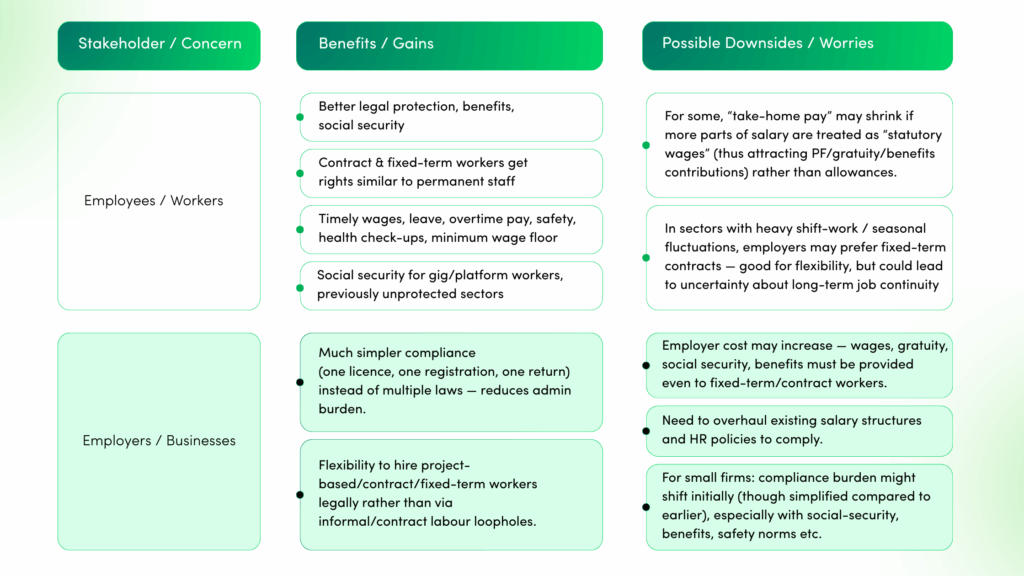
For Employees / Workers (Permanent, Fixed-Term, Gig, Contract, etc.) — What They Stand to Gain
- Better wage standards: minimum wages, more transparent pay structures, timely wage payments.
- More consistent benefits: gratuity eligibility sooner (1 year for fixed-term), social security (PF, insurance, ESIC), health check-ups, safety protections at workplaces.
- Formal documentation: appointment letters for all employees — even informal workers — which helps in asserting rights.
- Broader inclusion: gig workers, platform workers, contract workers, migrant workers — who were earlier often excluded — now covered under labour laws.
- Gender inclusivity and safety: women (and others) have clearer rights, including night shifts (with consent & safety), equal pay norms, etc.
- Better working-condition standards: regulated working hours, overtime pay, mandated welfare and safety facilities, standardised compliance for employers.
For Employers and Businesses — What Changes for Them (Good and Challenging)
Advantages / Ease for Employers:
- Simpler regulatory regime: less duplication, unified licences/registration, easier compliance.
- Clearer definitions reduce ambiguity — easier HR and payroll management.
- Flexible hiring models: fixed-term contracts are now legitimate and legally recognised, allowing businesses to adjust workforce based on demand, without fear of falling foul of older rigid laws.
- Easier layoff/closure: for many mid-sized firms (under thresholds), the process to lay off or restructure becomes simpler.
Challenges / Costs for Employers:
- With social security, gratuity, ESIC, PF, etc. applying to a broader employee base, cost of manpower goes up.
- Compliance with safety, working-condition norms, health benefits, documentation, contractors’ licensing — may increase administrative and financial burden.
- For firms employing many fixed-term or contract workers, giving them benefits similar to permanent staff raises cost.
- Smaller businesses may find even the simplified compliance harder to manage; state-level rules may vary and cause uncertainty.
labour law
But — and this is crucial — the benefits for employees come with trade-offs. For example: fixed-term employment brings flexibility, but job security may remain limited relative to permanent roles. Similarly, while employers must now provide better benefits, they may prioritise cost management through more fixed-term/contract hires, or automated workforce adjustments
What to Understand — and What to Watch Closely
- “Fixed-term” does not automatically mean “temporary without benefits.” Under the new codes, fixed-term workers get pay and benefits at par with permanent workers, including gratuity after one year.
- Gig and platform workers are now formally recognised. That means even delivery-app riders, freelance platform-based workers, etc. have claims to social security, insurance, PF/ESIC — though implementation (by platforms/aggregators) is key.
- Uniform definitions help, but actual benefits depend on compliance and state-level rules. The central codes provide structure, but many details — especially for social security, safety norms, and state-based labour law regulations — will depend on follow-up notifications by states.
- For small and micro employers, the shift may feel more burdensome initially. Even though compliance is simplified, compliance costs — safety equipment, documentation, welfare benefits, etc. — may increase, which might impact hiring or shift to more informal models.
- Potential shift in employer preference towards fixed-term / contract over permanent roles. Because fixed-term gives them flexibility (for fluctuating demand) while still meeting legal requirements, employers may increasingly prefer such hires — affecting long-term job security for many.
Why the Reform — and What It Aims to Do
- India’s old labour laws (some going back to 1920s–1950s) were often outdated, fragmented, overlapping, and confusing — poorly suited to the modern economy with offices, factories, gig work, contract work.
The new codes aim to build a modern, unified, future-ready labour ecosystem — one that balances worker protection with ease of doing business. - With a formal labour framework, more employees may enter the “formal sector,” gain social security, benefits — moving away from precarious informal work.
- For India as a whole, the hope is that simpler rules and better protections will attract investment, enable industries to scale, and create more stable employment — supporting long-term economic growth.
What It Means for You
- If you are working under contract, on a fixed-term basis, or even as a gig-worker (on a platform/aggregator), you could now have access to benefits similar to full-time permanent workers — including social security, health/insurance, gratuity (after 1 year), timely wages, documented job contracts.
- If you are a full-time employee — you may get more transparency, stronger legal protections, clearer definitions of wages/benefits.
- If you are planning to work nights (especially women) or engage in gig or platform work, the new codes offer better legal clarity and protections (provided employers comply).
- For employers/employers-to-be — it’s important to revise HR, payroll and compliance practices. Fixed-term hiring is now legitimate, but with associated benefits and obligations.
- For smaller businesses, or those hiring many contract/temporary/fixed-term workers — the compliance burden may rise, but the unified framework is meant to reduce complexity in the long run.
In Conclusion — A Major Shift, With Promise and Caution
The implementation of the four new labour law codes in November 2025 marks arguably the biggest change in India’s labour-law framework in decades. It attempts to bring India’s employment laws into the 21st century, reduce complexity, extend protections, and accommodate modern working arrangements — from gig work to contract labour to fixed-term hiring.
For workers — especially those in non-traditional work (gig platforms, contracts, etc.) — this could mean greater rights, clarity, and benefits. For employers — especially mid-sized or large firms — it could bring more flexibility, but also the responsibility of more robust compliance and fair treatment of workers.
That said, much will depend on implementation: how employers adapt, whether states frame complementary rules, and how compliance is enforced. For everyday workers, being aware of your rights under the new codes — around wages, employment letters, gratuity, social security, safety — is more important than ever.